










Need to know
- Therèse Havenga, of Momentum Savings notes, wealth is built on timeless habits and a mindset of discipline and consistency.
- Small savings grow through compounding; credit should be used carefully, not as a lifestyle.
- Clear goals and early action turn simple money habits into long-term financial security.
Think old-school money management is dead? Think again! You might be digitally savvy and comfortable with AI, but building real financial security still relies on foundational principles passed down through generations.
Here are 6 timeless money lessons you can apply today - no flashy social media trends required.
1. Money doesn’t buy happiness
Ever rolled your eyes whenever someone said ‘money doesn’t make you happy’? It easily sounds like sentimental fluff used to avoid talking about reality. But if you’ve been through a few financial ups and downs, you quickly learn some hard truths. While completely lacking money can make life an unbearable nightmare, money in large amounts is not going to make you proportionally happier. If you cannot be content with little, you won’t be content with a lot.
2. Saving can feel surprisingly good
Remember getting a bit of pocket money or a small cash gift when you were younger? When you’re little, even a relatively small amount can feel like an absolute fortune.
But it isn't just about the money. It is about the possibility. Saving is often presented as a sacrifice, but it can also be deeply empowering. Knowing you have a financial safety net means you don't have to rely on expensive credit or pay double for short-term gains. When you save for retirement, you’re buying that exact same feeling of possibility for your older self, building and securing a future you want, on your own terms.
Saving gives you options.
And options give you breathing room.
3. Time is your friend
You don’t need a massive income to build financial security, but you do need insight. It’s not about how much you save, but that you save - and that you start as early as possible.
Ironically, small amounts tucked away at the beginning of your career will grow much faster than huge amounts scrambled together at the end of your working years. When financial experts talk about the power of ‘time in the market’, they aren't just trying to make you feel good. They are talking about the unstoppable math of compound growth. Choosing the right savings vehicles - like tax-smart retirement annuities for long-term growth, or endowments and education plans for specific wealth goals, can help you put that math to work.
For example, if you get a windfall of R50 000, this is how well it will do for you over a period of 10, 20 or 30 years. We assume that the money will grow at 12% per year, and round off the numbers.
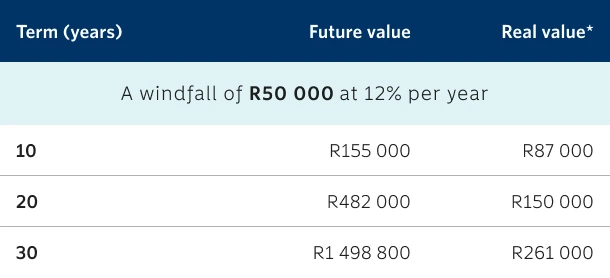
* Real value is a way to see how your saved money would look today, even if we look at it years from now.
4. Know where money really comes from
It is easy to get caught up hoping for a stroke of good luck, fortune, or a sudden windfall to fix your financial life. Relying on things like the Lotto is an illusion. History is full of stories of people who get a fortune only to lose it just as quickly. When you understand that money is a direct reflection of your hard work, your financial mindset shifts from chasing shortcuts to valuing steady progress. It might not sound glamorous, but it is one of the most grounding and empowering financial lessons of all.
5. Credit should be a tool, not a lifestyle
We’ve probably all done it – to chase up a credit card for things we wanted so badly: A new dress, a pair of shoes, a holiday. But if you sit down and do the math on how much those short-term impulses cost you over time in interest, it can make you feel completely nauseous.
Saving upfront for life’s treats makes them so much more enjoyable because they are completely yours - no lingering bills attached. Try to keep credit and loans for major expenses like buying a home or a car. You can also start saving towards these goals in advance, and avoid replacing your car as soon as it’s paid off. That doesn't mean credit is always bad. When life happens all at once - the car breaks down, the geyser bursts, and the timing is terrible - having access to credit can be an absolute blessing. The trick is treating credit as a strategic safety net rather than an everyday lifestyle.
6. Strive for a realistic goal
Setting and sticking to your financial goals isn't a superpower - it’s a proven science. If you’ve struggled to make your money resolutions stick, 90 years of research shows that a few simple structural tweaks can completely change your results. According to goal-setting research by psychologist Catherine Moore for PositivePsychology.com, achieving long-term financial stability comes down to these research-backed habits:

Final thoughts
In a world full of flashy fads and get-rich-quick trends, the most valuable lesson we can pass down is the power of active, conscious saving. Don't just sit back and hope your financial life improves. Define your target, name the goal, and take that first step.
At the end of the day, the best money lessons aren't complicated - and sometimes, the oldest wisdom is still the best place to start.
This blog post was adapted from an article seen on FA News..
Get advice
Start your conscious savings journey from only R500 per month with Momentum Savings. By partnering with a financial adviser, our long-term savings plans can be tailored to your exact goals - whether you’re saving for retirement, a dream home, or your child's education. It’s the easiest way to put these timeless principles into practice and gain the breathing room to secure your future.

Therèse Havenga
Head of Business Transformation at Momentum Savings
Therèse has over 20 years’ experience in financial services, spanning consumer insights, neuroscience, strategy, client experience, innovation and digital transformation. She holds a Master’s in Research Psychology and certifications in change management, product ownership, customer experience, coaching, and digital transformation. She is passionate about people-centred design, guiding transformation, and creating meaningful, insight-led impact.
Share this

@MomentumZA

@Momentum_za

Momentum_2

@momentumza

momentumgrouptv